Tiger Global in talks to make Apna India’s fastest unicorn – TechCrunch
Tiger Global in talks to make Apna India’s fastest unicorn – TechCrunch
Tiger Global in talks to make Apna India’s fastest unicorn – TechCrunch
Apna, a 21-month-old startup that is helping millions of blue and gray-collar workers in India upskill themselves, find communities and land jobs, is inching closer to becoming the fastest tech firm in the world’s second largest internet market to become a unicorn.
Tiger Global is in advanced stages of talks to lead a $100 million round in Apna, according to four sources familiar with the matter. The proposed terms value the startup at over $1 billion, the sources said.
The round hasn’t closed yet so terms of the deal may change, some of the sources cautioned.
If the round materializes, Apna will become the youngest Indian startup to attain the much coveted unicorn status. The startup, which launched its app in December 2019, was valued at $570 million in its Series B financing round in June this year. It will also be the third financing round Apna would have secured in a span of less than seven months.
Tiger Global, an existing investor in Apna, didn’t respond to a request for comment earlier this month. Apna founder and chief executive Nirmit Parikh, an Apple alum, declined to comment on Tuesday.
Indian cities are home to hundreds of millions of low-skilled workers who hail from villages in search of work. Many of them have lost their jobs amid the coronavirus pandemic that has slowed several economic activities in the world’s second-largest internet market.
Apna, whose name is inspired from a 2019 Bollywood song, is building a scalable networking infrastructure so that these workers can connect to the right employers and secure jobs. On its eponymous Android app, users also upskill themselves, review their interview skills, and become eligible for more jobs.
As of June this year, Apna had amassed over 10 million users and was facilitating more than 15 million job interviews each month. All jobs listed on the Apna platform are verified by the startup and free of cost for the candidates.
The startup has also partnered with some of India’s leading public and private organizations and is providing support to the Ministry of Minority Affairs of India, National Skill Development Corporation and UNICEF YuWaah to provide better skilling and job opportunities to candidates.
The investment talks further illustrates Tiger Global’s growing interest in India. The New York-headquartered firm has made several high-profile investments in India including in BharatPe, Gupshup, DealShare, Classplus, Urban Company, Coinswitch Kuber, and Groww.
More than two dozen Indian startups have become a unicorn this year, up from 11 last year, as several high-profile investors including Tiger Global, SoftBank, and Falcon Edge have increased the pace of their investments in the world’s second most populous nation.
Apna also counts Insight Partners, Lightspeed, and Sequoia Capital among its existing investors.
via Blogger https://ift.tt/3kGbyrB
September 01, 2021 at 12:48AM
via Blogger https://ift.tt/2Y8P3E1
September 01, 2021 at 12:48AM
via Blogger https://ift.tt/3jyFAxW
September 01, 2021 at 12:48AM
My radical love experiment shows there is light at the end of pandemic dating – and it isn’t a laptop screen | Patrick Lenton
My radical love experiment shows there is light at the end of pandemic dating – and it isn’t a laptop screen | Patrick Lenton
My radical love experiment shows there is light at the end of pandemic dating – and it isn’t a laptop screen | Patrick Lenton
I’ve always thought of dating as like a particularly complicated soup – which is perhaps why I was very single for many years.
My theory was that romance is a temperamental, finicky meal that calls for a truly baffling array of ingredients in order to be successful – some kind of five-star French delection that requires everything to be “just so”. Even if you do get all the correct ingredients (two consenting adults who are reasonably attracted to each other, a low-lit smoky bar on a Saturday night, enough alcohol to push through the awkward conversation), it’s still incredibly likely, almost guaranteed, that something will mess up the recipe and you’ll be left with a disaster, an inedible mess.
When you’re dating, you’re essentially practicing radical optimism, just hoping that if you throw enough of the right ingredients into the pot you’ll FINALLY find the right mixture, the perfect recipe. That’s how I approached dating, methodically, fact-based, trying to learn from my mistakes, hoping to work my way towards finding the right mixture of spices and potatoes to find love.
The reason I keep talking about my horrible soup theory is because somehow, impossibly, I’ve spent the entire duration of the Covid-19 pandemic (look it up if you’re not familiar) dating someone long distance across two states in various forms of lockdown, across hard borders. Bellissimo. Pandemic dating is like trying to delicately simmer a sauce while the kitchen is on fire and people are throwing knives at you, and you’re also just really sad all the time.
‘Falling in love with Eilish has been an adventure and a privilege, a pinch-yourself stroke of great luck, a once-in-a-lifetime moment of joy.’
During the first of Australia’s many lockdowns in 2020, I slid into the Twitter DMs of Eilish Gilligan, a ridiculously talented musician from Melbourne who I was a huge fan of and had never met. Our interactions had been limited to some work emails and a handful of Twitter likes. While I’d had a generalised crush on her for a while (I listened to her music a LOT), I did this without any real expectations or ulterior motive, except to get recommendations on the most efficient way to binge RuPaul’s Drag Race while I was stuck at home. I was in a fairly recent post-breakup stage and conducting a new romance was the last thing on my mind. I’d in fact “given up”, truly believing I was done putting myself on the rack of dating again. I was wrong and stupid, which should be my bio.
By July, realising that Melbourne wasn’t coming out of lockdown any time soon, we decided to do a Zoom date. I was so nervous I wore shoes. It was always meant to be a stopgap measure, something to pass the time before we could meet in real life and do a proper date. Instead, we then settled into five initial torturous months of online dating before we could finally meet in real life, then even more months afterwards of staring into the harsh light of a laptop screen and being absolutely riddled with yearning.
I’m not going to falsely deprecate my way through this – falling in love with Eilish has been an adventure and a privilege, a pinch-yourself stroke of great luck, a once-in-a-lifetime moment of joy. I am so happy. Falling in love always feels rare and special to the people involved – but dating across hard borders during a pandemic was slightly noteworthy in the sense that it was also a dystopian nightmare that I wouldn’t wish on anyone else. Unfortunately, we’re now in Australia’s second year of rolling lockdowns, with our two largest cities once again stuck inside. Even for people newly dating in the same locked-down city, there are elements of long distance involved. I’m often asked by people who are similarly trying to date online during the pandemic if I have any tips on how to cook that nice soup during lockdown. I’ve always been unlucky in love, so I wouldn’t ask me for advice about anything, but whatever.
Eilish and I did a lot of online dating things, which felt like doing gluten-free substitutions in the romance soup recipes – it’s never going to be as good as a late-night drink in the dark corner of a bar, but it’s better than nothing. Our first few dates were PowerPoint presentations about ourselves – mine was called “So You’ve Decided To Get To Know Patrick Lenton – Weird”. Hers was called “Eilish Gilligan 101”. We watched films, TV, compilations of YouTube videos for hours. We took it offline, sending letters back and forth, often written in a faux Jane Austen style, as we were aware of the anachronism of actually sending love letters to someone we’d never seen in real life. We sent packages and gifts back and forth. After a while, we’d simply talk and then end up staring at each other for hours at a time, the only sound the frogs croaking in chorus from her house; sirens and the late-night cityscape from mine. I’m not sure if any of those count as tips; they’re just what we did.
‘Eilish Gilligan (pictured) and I did a lot of online dating things. Our first few dates were PowerPoint presentations about ourselves.’
One night months into our online dating in the rare silence that a city only gets at 2am, I was staring intently at my laptop screen and the face of the beautiful girl being beamed into my room across the hundreds of miles from Sydney to Melbourne, across hard borders, through lockdown laws and curfews. We were completely silent and had been for a while, the earlier hours of conversation evaporating into what we were always left with after five months of enforced long-distance lockdown dating: palpable and seething yearning, the frustrated desire to simply meet someone you’re falling in love with.
On that night, for the first time, I think the hysteria of it all properly cracked me. Without thinking I absently stroked the back of my laptop like it was her head, and I had the intrusive thought that in real life, her head would be as smooth and flat and as two-dimensional as the back of a laptop. I couldn’t shake it, couldn’t stop obsessing over the idea of this woman having a flat skull that perhaps thrummed with static like the back of a MacBook, and in that dark quiet room after I finally said goodnight and closed my laptop, I started laughing hopelessly about the thought. It would be months still until I would finally be able to prove my delirium incorrect.
I’m thrilled to report that she has a very nice 3D skull. When we finally met in person, it was more scary than a first date, because it came with months of expectation and weight. We were hysterical, babbling, perched on the edge of a couch in an AirBnb, as jumpy as long-tailed cats in a room full of rocking chairs.
I think what this story of hysteria highlights for me is that even with all the hurdles the pandemic placed in front of us, with the longing and the fear and ever-present self-doubt (what if she hates the fact I look like a long fancy greyhound? What if our pheromones don’t match? What if she’s catfishing me for the TV show Catfish?), we still somehow magically persevered. We fell in love (huge brag!!). We celebrated a one-year anniversary. I’m now in Melbourne, and in a few weeks (lockdowns yet again pending) we’re moving in together.
Somehow, it all came together – which I think means that the whole soup theory is absolutely bogus. Maybe that’s not helpful to people, but I think in the end my message is actually one of radical optimism and hope – because perhaps it shows that love can happen anywhere, can grow in the most infertile and unlikely soils, online or offline, it doesn’t matter. There is no recipe, no ingredients, no secret blend of herbs and spices – there is simply a mysterious romantic chaos that you can’t game or predict, that can strike at any moment, and not even the pandemic can stifle. I find that comforting. I find that nice.
via Blogger https://ift.tt/3zysbf7
September 01, 2021 at 12:48AM
via Blogger https://ift.tt/38vDQPM
September 01, 2021 at 12:48AM
via Blogger https://ift.tt/3ztc0zD
September 01, 2021 at 12:48AM
Release Date, Song Titles, & More – Hollywood Life
Release Date, Song Titles, & More – Hollywood Life
Release Date, Song Titles, & More – Hollywood Life
After making history with a pair of albums in 2020, Bad Bunny has teamed up with Tommy Torres for ‘El Playlist de Anoche.’ Here’s what you need to know.
2020 was the year of Bad Bunny, and 2021 isn’t looking so bad for the Puerto Rican singer/rapper, either. Bunny (b. Benito Martinez) made the best of the bad year with two massively successful projects: the 24-time Multi-platinum album YHLQMDLG and El Último Tour Del Mundo, which became the first all-Spanish language album to reach No. 1 on the U.S. Billboard 200 Chart. While most musicians would take the rest of the decade off after such an incredible performance, Bad Bunny hopped back to work by teaming up with Puerto Rican Latin pop star Tommy Torres for El Playlist de Anoche.
Technically, El Playlist de Anoche (Spanish for “Last Night’s Playlist”) is a Tommy Torres album, but this is a collaborative album in nature, with Tommy and Bunny co-writing and co-producing all of the album’s nine tracks. It’s Tommy’s fifth studio album and the first since 2012’s 12 Historias. Tommy, born in San Juan, Puerto Rico, has been involved in the Latin music scene since the late 1990s. His first recorded composition, “No Puedo Olvidar” by pop group MDO, hit No. 1 on the Billboard Hot Latin Tracks chart. Since then, he has had a successful career both behind the scenes and in the spotlight. Some highlights include: producing Ricky Martin’s MTV Unplugged special in 2006; scooping up numerous Latin Grammy Awards (while winning the Grammy for Best Latin Pop Album, Paraiso Express, in 2010) as well as winning Composer of the Year at 2010’s ASCAP’s Latin Music Awards. In 2001, he embarked on a solo career, releasing music that made him a star in his native Puerto Rico and across the Spanish-speaking world.
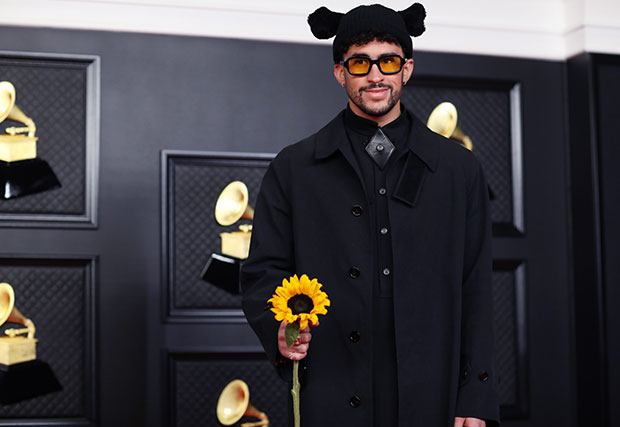
Bad Bunny at the 63rd Annual Grammy Awards (Jay L Clendenin/Los Angeles Times/Shutterstock)
For Bad Bunny, it seems like now would be a good time to develop his producer chops. As of 20201, Bad Bunny has released four albums: 2018’s X 100pre, 2019’s Oasis (with J Balvin), and 2020’s 1-2 punch – YHLQMDLG, short for “Yo Hago Lo Que Me Da La Gana” (Spanish for “I Do What I Want”); and El Último Tour del Mundo (“The Last Tour Of The World”). The latter featured collaborations with Rosalía (“La Noche de Anoche”) and Jhay Cortez (“Dákiti”), while the former saw Bunny work with Daddy Yankee (“La Santa”) and artists like Yaviah, Ñengo Flow, Sech, Myke Towers, and more. In between the albums, Bad Bunny released Las que no iban a salir (Spanish for “The Ones That Were Not Coming Out”) a compilation album. Oh, he also appeared on the “Moonlight Edition” of Dua Lipa’s Future Nostalgia, joining her for “Un Día (One Day)” with J Balvin and Tainy. The song earned them a Grammy nod for Best Pop Duo/Group Performance at the 2021 awards.
So, with all that going on, how did El Playlist de Anoche come about, and what’s next for Bad Bunny and Tommy?
The Release Date of ‘El Playlist de Anoche’
Tommy Torres (Thais Llorca/EPA/Shutterstock)
El Playlist de Anoche arrived on July 23, 2021. It came via Rimas Entertainment, an independent label run by CEO Noah Assad — who also happens to be Bad Bunny’s manager, according to Billboard.
“I can’t say I was surprised, because Bunny always keeps me on my toes,” Assad told Billboard about Bunny co-writing and co-producing the album. “He’s always reinventing and thinking of new ways to explore into a different world and when he told me about this one, I literally jumped up in excitement. It’s something that, as always, no one sees coming.”
The team up was successful. After nearly eight years’ absence from the Billboard Top Latin Albums chart, El Playlist de Anoche debuted at No. 7. “I felt such a crazy excitement from fans since the album was released,” he told Billboard. “So, comparing that to past experiences with my last three releases, I would lie if I told you I didn’t have the expectation for it to debut in the top 10. Obviously, times are different now, since it’s more about streaming-based than actual sales, but still, the positive reaction has been crazy.” The album also climbed the Spotify and Apple Music charts.
Bad Bunny at the 63rd Grammy Awards (Chris Pizzello/Invision/AP/Shutterstock)
Why Did The Artists Collaborate Together?
Bunny and Tommy first met in 2019 at the Coliseo de Puerto Rico. Tommy had been recruited to play piano on the ballad “Amorfoda.” However, as Bunny told Billboard in a digital cover story, it “happened so fast,” and they didn’t really keep in touch.
“One day last year, I was at the Rimas office, and I said that I had written a song that I thought would be perfect for Tommy to sing,” Bunny told Billboard. “I had never told anyone or made an approach until that moment because I thought, ‘Why would Tommy, who writes canciones cabronas [badass songs], want me to write a song for him?’ But one of his team members was there and said, ‘I think Tommy would really like that idea.” So they called him right then and there, and he said yes.’
“I’ve been producing for other artists many years now,” added Tommy, “but this is the first time that an artist-producer tells me, ‘I want to do something for you.’ To have someone like Benito, who has been surfing across a wave of creativity and really gets this generation — well, it doesn’t get any better than that.”
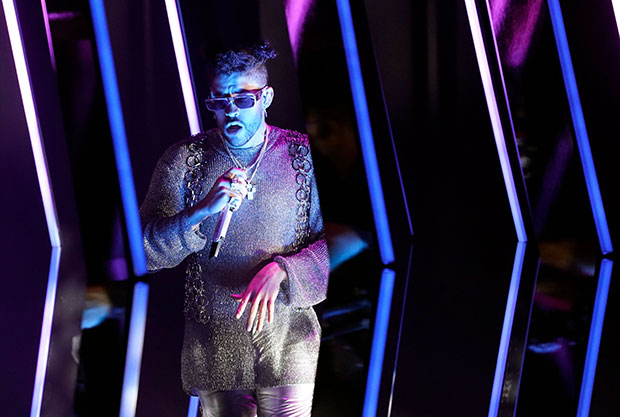
Bad Bunny at the 2021 Billboard Music Awards (Rob Latour/Shutterstock)
The two rented an AirB&B in West Hollywood and spent two weeks writing and producing nine songs. “We didn’t talk about a strategy, what we wanted it to sound like, nothing. We just showed up and started making music,” said Bad Bunny. Tommy said that not having any expectations from a label or a producer was “liberating,” but there were some challenges. How Bunny “phrases parts of the song” was completely different from how Tommy would phrase it. Learning how Bunny would sing things was like, as Tommy said, “learning a new instrument.”
Tommy told Billboard that the song “Demasiado Amor” is “a great example of how we wrote [together]. We’d get to the studio, talk about a million things, eat sushi and then sit and play the piano, and boom, in less than an hour and a half, we’d write an entire song. One, because the sessions just flowed so well and two, because Benito comes up with ideas so fast, it’s out of this world.”
“We didn’t do this because one of us needed to,” said Bunny. “And no one is doing a favor for anyone. It just happened. We wanted this, and it felt right.” That feeling extended to the album. No other voices are on the record besides Tommy and Bad Bunny’s.
Plans for Tommy Torres and Bad Bunny
As of Aug. 2021, Tommy has a trio of dates set in Puerto Rico at the start of January 2022, per Songkick. Bad Bunny will kick off a massive tour in February 2022, per Songkick. It doesn’t appear like the two have any planned concerts together, but considering the spontaneity of this album, that could change in a heartbeat.
via Blogger https://ift.tt/38pUAbn
September 01, 2021 at 12:48AM
via Blogger https://ift.tt/3zKn5w8
September 01, 2021 at 12:48AM
via Blogger https://ift.tt/3mJtrse
September 01, 2021 at 12:48AM
Historic London Synagogue Fights to Stay Out of the Shadows
Historic London Synagogue Fights to Stay Out of the Shadows
Historic London Synagogue Fights to Stay Out of the Shadows
LONDON — Rabbi Shalom Morris picked his way through a steel scaffold that construction workers were noisily dismantling as he showed a visitor around his 320-year-old synagogue, Bevis Marks. When the renovation is finished, there will be a new visitors center off the snug courtyard outside the building.
But Rabbi Morris was less preoccupied with his own construction project than two others for which developers are seeking approval next door. Both are office towers — 20 and 48 stories, respectively — and if they are built, he said, they would leave one of London’s most venerable houses of worship in near-permanent twilight.
“If this was next to St. Paul’s Cathedral, it wouldn’t happen,” said Rabbi Morris, 41, a former New Yorker who has overseen the synagogue, the oldest in Britain, for six years. “They’re willing, at best, to roll the dice and, at worst, to do lasting harm.”
It’s not that the rabbi has it in for all skyscrapers. Bevis Marks already nestles in a glass and steel forest of thrusting towers, many with goofy nicknames — the Gherkin, the Walkie Talkie, the Cheesegrater — which have transformed London’s financial district, known as the City, into a kind of Legoland version of Chicago.
But Rabbi Morris claims that these latest towers, to the immediate east and south of Bevis Marks, would be a “tipping point,” blocking the already precious London sunlight that now streams through its arched windows, from morning well into the afternoon. The synagogue’s landmark status limits it from augmenting its artificial light, which is supplied by 1920s sconces affixed to its supporting pillars.
“There’s this incredible serenity in the courtyard that prepares you for entering the synagogue,” Rabbi Morris said. “But when you have 50 stories peering down on you, putting you in the shadows, that experience is lost.”
That assertion is open to debate: The developers have commissioned studies that they say show there would be very little loss of sunlight. The synagogue has competing studies that show there would be a lot. But there’s no dispute that Bevis Marks has long been hemmed in by the world of commerce that grew up around it — and a pair of looming skyscrapers would add to the sense of enclosure.
Now ringed by lower-rise office buildings and reached through an easy-to-miss stone archway, the reddish brick synagogue was built in 1701 to blend in with its surroundings, in a classical style influenced by Christopher Wren, the architect of St. Paul’s.
Its first worshipers were Jews from Portugal and Spain who fled the Inquisition and were allowed by Oliver Cromwell in 1657 to practice their faith in England. The congregation today is a mix of descendants of those Sephardic Jews and a scattering of office workers who drop by for morning prayers.
Tensions over tall buildings, familiar to New Yorkers chafing at luxury skyscrapers just south of Central Park, are nothing new in London. That’s particularly true in the City, which dates to London’s Roman origins and has dozens of historically significant buildings, from the Guildhall to the Bank of England.
The deep symbolism of Bevis Marks to London’s Jewish community, however, makes this more than an ordinary dust-up between developers and the custodians of a landmark site.
“Religious buildings need to be treated with particular care,” said Stephen Graham, a professor of cities and society at Newcastle University. “Light is an essential part of the spiritual experience. It’s unthinkable that a cathedral would be confronted with his kind of challenge, so why should a synagogue?”
The two towers under scrutiny are rather modest by the flamboyant standards of some City skyscrapers. They are in different stages of a long review process, but both could be approved by the end of the year.
Welput, a property fund that is developing the taller one, at 31 Bury Street, declined to comment on how its building would affect the synagogue because it was in a public consultation period. Merchant Land, the developer of the other, at 33 Creechurch Lane, said studies showed that its building would have no significant negative impact and that it had worked with the synagogue since 2017 to try to assuage its concerns about daylight.
“Merchant Land recognizes that not all the synagogue’s objections have been resolved to their satisfaction,” it said in a statement, adding that it was “committed to building a positive relationship based on accommodating each other’s needs.”
Rabbi Morris has rallied his several hundred congregants to submit objections to the projects. With anti-Semitism surging in Europe and the United States — and infecting Britain’s political discourse, particularly in the ranks of the Labour Party — he and other backers of Bevis Marks argue that the city’s planners should go the extra mile to protect it.
“It makes the preservation of this place all the more important,” said Sir Michael Bear, a former Lord Mayor of London who is Jewish and whose daughter was married in Bevis Marks. “What is happening here is a casualty of a flawed planning process.”
Mr. Bear, an engineer and developer who built the sprawling Spitalfields market in East London, said he believed there was a good chance that one or both of the projects would be approved. There was a tremendous push, he said, to approve new office towers to demonstrate that the city had rebounded after Brexit and the coronavirus pandemic. The paradox is that the pandemic has raised lingering questions about the future of the workplace and who will fill these giant buildings.
Even now, with much of London returning to a normal bustle, the City remains quiet, many of its towers still mostly deserted. But the pounding of pile-drivers and jackhammers echoes through the streets, as more skyscrapers join them.
Bevis Marks angered some of its congregants in 2018 when it urged them to object to a third proposed tower nearby on the same grounds, but then abruptly withdrew its opposition after the developer agreed to donate an undisclosed amount of money to help build the visitors center. Rabbi Morris now says the decision to cut a deal was a mistake.
The 56-story wedge-shaped tower, nicknamed Cheesegrater 2, was approved but has not yet been built. The synagogue ended up financing the visitors center from other sources, including a grant of 2.8 million pounds, or $3.8 million, from the National Lottery Heritage Fund, which disburses funds raised through the lottery to projects that preserve the nation’s heritage.
Prince Charles is a patron of the center, which the rabbi says will exhibit relics from the synagogue’s collection, including ceremonial silver and vestments. Charles has never been shy about wading into London development issues (he once famously described a proposed modernist extension to the National Gallery as a “monstrous carbuncle on the face of a much loved and elegant friend”). But he has yet to get involved in this dispute.
The City of London Corporation, which will decide on the new towers, declined to comment, as did London’s mayor, Sadiq Khan. Mr. Khan has periodically used his powers to try to block projects, including the Tulip, a bulbous observation tower proposed to stand next to the Gherkin.
Professor Graham, whose book “Vertical” explores the impulse to build upward, said the pressure to approve towers in London would persist because of the misbegotten belief that “to be a global city, you have to have a New York-style skyline.” In this case, he said, it has led to a fascination with “toylike, identifiable towers” that stand in stark contrast to the classic, Wren-like aesthetic of the Bevis Marks synagogue.
“We recognize that the city wants to develop in a certain way,” said Rabbi Morris, as he strolled past the Gherkin, craning his neck skyward. “But there’s a tone deafness to the implications of this.”
via Blogger https://ift.tt/3gRhxbV
September 01, 2021 at 12:48AM
via Blogger https://ift.tt/3kDuK9j
September 01, 2021 at 12:48AM
via Blogger https://ift.tt/3kFrOJn
September 01, 2021 at 12:48AM
Google delays return to office to January
Google delays return to office to January
Google delays return to office to January
Sundar Pichai, chief executive officer of Alphabet Inc., wears a protective mask while attending a meeting with U.S. President Joe Biden, not pictured, in the East Room of the White House in Washington, D.C., on Wednesday, Aug. 25, 2021.
Stefani Reynolds | Bloomberg | Getty Images
Google is postponing its voluntary return to the office to Jan. 10, CEO Sundar Pichai announced in a blog post Tuesday.
The news comes as several tech companies including Amazon, Facebook and Apple reassess return to office plans amid the spread of the highly contagious delta variant of the Covid-19 virus.
Pichai said the extension will offer workers more flexibility and that beyond Jan. 10 the company will allow countries and different locations to decide when to end the voluntary work-from-home conditions with at least a 30-day notice. Google has continuously adjusted its Covid-related workplace policies based on what various geographies’ government health experts recommend.
“The road ahead may be a little longer and bumpier than we hoped, yet I remain optimistic that we will get through it together,” Pichai said.
This is the company’s third delay. Last December, Google delayed its return to offices to Sept. 1, after which employees would be required to work in person for at least three days a week.
In July, Pichai announced a second delay, to Oct. 18, and announced returning workers would be required to get the vaccination.
via Blogger https://ift.tt/3mQuIOa
September 01, 2021 at 12:48AM
via Blogger https://ift.tt/3jwExyT
September 01, 2021 at 12:48AM
via Blogger https://ift.tt/3juTLUL
September 01, 2021 at 12:48AM
Dire Once-in-a-Century Storms Could Become Annual Events Soon, Scientists Warn
Dire Once-in-a-Century Storms Could Become Annual Events Soon, Scientists Warn
The best case scenario for the climate crisis is looking increasingly disastrous for much of the world, especially when it comes to rising seas.
Even if we can limit global warming below 2 degrees Celsius, in line with the Paris Climate Accord, by 2100 many coastal regions could be experiencing once-in-a-century sea level threats, such as storm surges, high tides and threatening waves, at least once a year.
That’s a 100-fold increase in coastal flooding, and according to new global models, that’s if we’re lucky. If we do nothing to change our behavior, the world could soon blow past 2 degrees Celsius of warming, at which point sea level scenarios will grow significantly worse.
Recent projections for more than 7,000 coastal locations around the world suggest that at 1.5 degrees of warming, at least half of the sites studied will be annually affected by extreme sea level events.
At 2 degrees Celsius of warming, a further 14 percent will experience the same by 2100.
In all likelihood, some locations will suffer these effects even sooner. Under the 1.5 degree scenario, for instance, some coastal locations could experience a 100-fold increase in extreme sea level events by as early as the 2070s.
The authors say this is “overwhelmingly true” for places in the tropics, like Hawaii and the Caribbean, as well as the southern half of North America’s Pacific coast, all of which appear particularly vulnerable to rising seas. As more sea ice melts, parts of the Mediterranean coast and the Arabian Peninsula could also become hotspots for extreme sea level activity.
“The tropics appear more sensitive than the northern high latitudes,” the authors write, “where some locations do not see this frequency change even for the highest global warming levels.”
The results align with recent sea level projections, which suggest we have been seriously underestimating the rise of our oceans at the lower ends of global warming.
Already this year, a study found sea level rise is impacting coastal areas four times faster than we thought. The miscalculations have a lot to do with uncertainties regarding projected sea level rise and how it will shake out the world over – there are a lot of variables to include in the calculations.
The new model seeks to make up for these limitations. It is based on a ‘voting’ system, which helps to balance out various different scenarios of sea level rise and the many uncertainties involved.
For all six scenarios of warming by 2100, researchers took the median values at which sea level events become annual and used these as individual ‘votes’. The ‘majority vote’ was therefore the lowest warming level at which the frequency of storm surges and other sea level events became annual disasters.
This democratic system was first applied to data on extreme sea level events from a smaller subset of 179 coastal locations, before being expanded to a larger set of 7,283 locations.
In the end, the authors found a majority vote that agreed 43 percent of all coastal locations studied will experience extreme sea level events on an annual basis, even at the lower end of 1.5 degrees of warming.
What’s more, many of these coastal regions will experience these effects before the end of the century, possibly even as soon as 2070.
At 2 degrees of warming, the majority vote suggests a further 15 percent more coastline will be affected. At 3 degrees of warming, this dire scenario could hit as early as 2060.
Still, that’s just what the majority vote suggests. Some of the more pessimistic data points on each of the six distributions indicate that 99 percent of all locations could experience extreme sea level events at 1.5 degrees of warming.
The findings highlight a “substantial level of disagreement among the six estimates”, which suggests there’s still a whole lot of uncertainty in our models.
The most optimistic voting outcome, for instance, suggests only 2 percent of all coastal regions studied will experience extreme sea level events under the same warming scenario. But that optimistic scenario requires a “very strict” unanimous vote across all six estimates that probably wouldn’t happen often.
Once again, the new study highlights we need further research to refine our sea level models to see where the worst effects will strike first. While some parts of North America’s Atlantic coast could be hit by dramatic flooding, the study predicts other nearby regions will remain entirely unaffected.
Why this wild variation occurs in such nearby locations will need to be further analyzed, but it’s something that other researchers have noticed before – an artifact of the scientific difficulties involved in putting firm numbers on sea level rise.
For instance, even in a terrible scenario where global warming reaches past 5 degrees Celsius and ice sheets virtually disappear the world over, the majority vote suggests approximately 20 percent of all the coastal sites studied will remain unaffected by extreme sea level events.
Northern coastal regions like Alaska and northern Europe are those that seem to be most safe from these future disasters.
“Our findings have important policy and practical implications as they highlight that even if the Paris Agreement goals will be achieved, extreme events potentially conducive to coastal flooding will be experienced at unprecedented frequencies in many parts of the world’s coasts,” the authors write.
Tiger Global in talks to make Apna India’s fastest unicorn – TechCrunch
Tiger Global in talks to make Apna India’s fastest unicorn – TechCrunch
Apna, a 21-month-old startup that is helping millions of blue and gray-collar workers in India upskill themselves, find communities and land jobs, is inching closer to becoming the fastest tech firm in the world’s second largest internet market to become a unicorn.
Tiger Global is in advanced stages of talks to lead a $100 million round in Apna, according to four sources familiar with the matter. The proposed terms value the startup at over $1 billion, the sources said.
The round hasn’t closed yet so terms of the deal may change, some of the sources cautioned.
If the round materializes, Apna will become the youngest Indian startup to attain the much coveted unicorn status. The startup, which launched its app in December 2019, was valued at $570 million in its Series B financing round in June this year. It will also be the third financing round Apna would have secured in a span of less than seven months.
Tiger Global, an existing investor in Apna, didn’t respond to a request for comment earlier this month. Apna founder and chief executive Nirmit Parikh, an Apple alum, declined to comment on Tuesday.
Indian cities are home to hundreds of millions of low-skilled workers who hail from villages in search of work. Many of them have lost their jobs amid the coronavirus pandemic that has slowed several economic activities in the world’s second-largest internet market.
Apna, whose name is inspired from a 2019 Bollywood song, is building a scalable networking infrastructure so that these workers can connect to the right employers and secure jobs. On its eponymous Android app, users also upskill themselves, review their interview skills, and become eligible for more jobs.
As of June this year, Apna had amassed over 10 million users and was facilitating more than 15 million job interviews each month. All jobs listed on the Apna platform are verified by the startup and free of cost for the candidates.
The startup has also partnered with some of India’s leading public and private organizations and is providing support to the Ministry of Minority Affairs of India, National Skill Development Corporation and UNICEF YuWaah to provide better skilling and job opportunities to candidates.
The investment talks further illustrates Tiger Global’s growing interest in India. The New York-headquartered firm has made several high-profile investments in India including in BharatPe, Gupshup, DealShare, Classplus, Urban Company, Coinswitch Kuber, and Groww.
More than two dozen Indian startups have become a unicorn this year, up from 11 last year, as several high-profile investors including Tiger Global, SoftBank, and Falcon Edge have increased the pace of their investments in the world’s second most populous nation.
Apna also counts Insight Partners, Lightspeed, and Sequoia Capital among its existing investors.
My radical love experiment shows there is light at the end of pandemic dating – and it isn’t a laptop screen | Patrick Lenton
My radical love experiment shows there is light at the end of pandemic dating – and it isn’t a laptop screen | Patrick Lenton
I’ve always thought of dating as like a particularly complicated soup – which is perhaps why I was very single for many years.
My theory was that romance is a temperamental, finicky meal that calls for a truly baffling array of ingredients in order to be successful – some kind of five-star French delection that requires everything to be “just so”. Even if you do get all the correct ingredients (two consenting adults who are reasonably attracted to each other, a low-lit smoky bar on a Saturday night, enough alcohol to push through the awkward conversation), it’s still incredibly likely, almost guaranteed, that something will mess up the recipe and you’ll be left with a disaster, an inedible mess.
When you’re dating, you’re essentially practicing radical optimism, just hoping that if you throw enough of the right ingredients into the pot you’ll FINALLY find the right mixture, the perfect recipe. That’s how I approached dating, methodically, fact-based, trying to learn from my mistakes, hoping to work my way towards finding the right mixture of spices and potatoes to find love.
The reason I keep talking about my horrible soup theory is because somehow, impossibly, I’ve spent the entire duration of the Covid-19 pandemic (look it up if you’re not familiar) dating someone long distance across two states in various forms of lockdown, across hard borders. Bellissimo. Pandemic dating is like trying to delicately simmer a sauce while the kitchen is on fire and people are throwing knives at you, and you’re also just really sad all the time.
‘Falling in love with Eilish has been an adventure and a privilege, a pinch-yourself stroke of great luck, a once-in-a-lifetime moment of joy.’
During the first of Australia’s many lockdowns in 2020, I slid into the Twitter DMs of Eilish Gilligan, a ridiculously talented musician from Melbourne who I was a huge fan of and had never met. Our interactions had been limited to some work emails and a handful of Twitter likes. While I’d had a generalised crush on her for a while (I listened to her music a LOT), I did this without any real expectations or ulterior motive, except to get recommendations on the most efficient way to binge RuPaul’s Drag Race while I was stuck at home. I was in a fairly recent post-breakup stage and conducting a new romance was the last thing on my mind. I’d in fact “given up”, truly believing I was done putting myself on the rack of dating again. I was wrong and stupid, which should be my bio.
By July, realising that Melbourne wasn’t coming out of lockdown any time soon, we decided to do a Zoom date. I was so nervous I wore shoes. It was always meant to be a stopgap measure, something to pass the time before we could meet in real life and do a proper date. Instead, we then settled into five initial torturous months of online dating before we could finally meet in real life, then even more months afterwards of staring into the harsh light of a laptop screen and being absolutely riddled with yearning.
I’m not going to falsely deprecate my way through this – falling in love with Eilish has been an adventure and a privilege, a pinch-yourself stroke of great luck, a once-in-a-lifetime moment of joy. I am so happy. Falling in love always feels rare and special to the people involved – but dating across hard borders during a pandemic was slightly noteworthy in the sense that it was also a dystopian nightmare that I wouldn’t wish on anyone else. Unfortunately, we’re now in Australia’s second year of rolling lockdowns, with our two largest cities once again stuck inside. Even for people newly dating in the same locked-down city, there are elements of long distance involved. I’m often asked by people who are similarly trying to date online during the pandemic if I have any tips on how to cook that nice soup during lockdown. I’ve always been unlucky in love, so I wouldn’t ask me for advice about anything, but whatever.
Eilish and I did a lot of online dating things, which felt like doing gluten-free substitutions in the romance soup recipes – it’s never going to be as good as a late-night drink in the dark corner of a bar, but it’s better than nothing. Our first few dates were PowerPoint presentations about ourselves – mine was called “So You’ve Decided To Get To Know Patrick Lenton – Weird”. Hers was called “Eilish Gilligan 101”. We watched films, TV, compilations of YouTube videos for hours. We took it offline, sending letters back and forth, often written in a faux Jane Austen style, as we were aware of the anachronism of actually sending love letters to someone we’d never seen in real life. We sent packages and gifts back and forth. After a while, we’d simply talk and then end up staring at each other for hours at a time, the only sound the frogs croaking in chorus from her house; sirens and the late-night cityscape from mine. I’m not sure if any of those count as tips; they’re just what we did.
‘Eilish Gilligan (pictured) and I did a lot of online dating things. Our first few dates were PowerPoint presentations about ourselves.’
One night months into our online dating in the rare silence that a city only gets at 2am, I was staring intently at my laptop screen and the face of the beautiful girl being beamed into my room across the hundreds of miles from Sydney to Melbourne, across hard borders, through lockdown laws and curfews. We were completely silent and had been for a while, the earlier hours of conversation evaporating into what we were always left with after five months of enforced long-distance lockdown dating: palpable and seething yearning, the frustrated desire to simply meet someone you’re falling in love with.
On that night, for the first time, I think the hysteria of it all properly cracked me. Without thinking I absently stroked the back of my laptop like it was her head, and I had the intrusive thought that in real life, her head would be as smooth and flat and as two-dimensional as the back of a laptop. I couldn’t shake it, couldn’t stop obsessing over the idea of this woman having a flat skull that perhaps thrummed with static like the back of a MacBook, and in that dark quiet room after I finally said goodnight and closed my laptop, I started laughing hopelessly about the thought. It would be months still until I would finally be able to prove my delirium incorrect.
I’m thrilled to report that she has a very nice 3D skull. When we finally met in person, it was more scary than a first date, because it came with months of expectation and weight. We were hysterical, babbling, perched on the edge of a couch in an AirBnb, as jumpy as long-tailed cats in a room full of rocking chairs.
I think what this story of hysteria highlights for me is that even with all the hurdles the pandemic placed in front of us, with the longing and the fear and ever-present self-doubt (what if she hates the fact I look like a long fancy greyhound? What if our pheromones don’t match? What if she’s catfishing me for the TV show Catfish?), we still somehow magically persevered. We fell in love (huge brag!!). We celebrated a one-year anniversary. I’m now in Melbourne, and in a few weeks (lockdowns yet again pending) we’re moving in together.
Somehow, it all came together – which I think means that the whole soup theory is absolutely bogus. Maybe that’s not helpful to people, but I think in the end my message is actually one of radical optimism and hope – because perhaps it shows that love can happen anywhere, can grow in the most infertile and unlikely soils, online or offline, it doesn’t matter. There is no recipe, no ingredients, no secret blend of herbs and spices – there is simply a mysterious romantic chaos that you can’t game or predict, that can strike at any moment, and not even the pandemic can stifle. I find that comforting. I find that nice.
Release Date, Song Titles, & More – Hollywood Life
Release Date, Song Titles, & More – Hollywood Life
After making history with a pair of albums in 2020, Bad Bunny has teamed up with Tommy Torres for ‘El Playlist de Anoche.’ Here’s what you need to know.
2020 was the year of Bad Bunny, and 2021 isn’t looking so bad for the Puerto Rican singer/rapper, either. Bunny (b. Benito Martinez) made the best of the bad year with two massively successful projects: the 24-time Multi-platinum album YHLQMDLG and El Último Tour Del Mundo, which became the first all-Spanish language album to reach No. 1 on the U.S. Billboard 200 Chart. While most musicians would take the rest of the decade off after such an incredible performance, Bad Bunny hopped back to work by teaming up with Puerto Rican Latin pop star Tommy Torres for El Playlist de Anoche.
Technically, El Playlist de Anoche (Spanish for “Last Night’s Playlist”) is a Tommy Torres album, but this is a collaborative album in nature, with Tommy and Bunny co-writing and co-producing all of the album’s nine tracks. It’s Tommy’s fifth studio album and the first since 2012’s 12 Historias. Tommy, born in San Juan, Puerto Rico, has been involved in the Latin music scene since the late 1990s. His first recorded composition, “No Puedo Olvidar” by pop group MDO, hit No. 1 on the Billboard Hot Latin Tracks chart. Since then, he has had a successful career both behind the scenes and in the spotlight. Some highlights include: producing Ricky Martin’s MTV Unplugged special in 2006; scooping up numerous Latin Grammy Awards (while winning the Grammy for Best Latin Pop Album, Paraiso Express, in 2010) as well as winning Composer of the Year at 2010’s ASCAP’s Latin Music Awards. In 2001, he embarked on a solo career, releasing music that made him a star in his native Puerto Rico and across the Spanish-speaking world.
Bad Bunny at the 63rd Annual Grammy Awards (Jay L Clendenin/Los Angeles Times/Shutterstock)
For Bad Bunny, it seems like now would be a good time to develop his producer chops. As of 20201, Bad Bunny has released four albums: 2018’s X 100pre, 2019’s Oasis (with J Balvin), and 2020’s 1-2 punch – YHLQMDLG, short for “Yo Hago Lo Que Me Da La Gana” (Spanish for “I Do What I Want”); and El Último Tour del Mundo (“The Last Tour Of The World”). The latter featured collaborations with Rosalía (“La Noche de Anoche”) and Jhay Cortez (“Dákiti”), while the former saw Bunny work with Daddy Yankee (“La Santa”) and artists like Yaviah, Ñengo Flow, Sech, Myke Towers, and more. In between the albums, Bad Bunny released Las que no iban a salir (Spanish for “The Ones That Were Not Coming Out”) a compilation album. Oh, he also appeared on the “Moonlight Edition” of Dua Lipa’s Future Nostalgia, joining her for “Un Día (One Day)” with J Balvin and Tainy. The song earned them a Grammy nod for Best Pop Duo/Group Performance at the 2021 awards.
So, with all that going on, how did El Playlist de Anoche come about, and what’s next for Bad Bunny and Tommy?
The Release Date of ‘El Playlist de Anoche’
Tommy Torres (Thais Llorca/EPA/Shutterstock)
El Playlist de Anoche arrived on July 23, 2021. It came via Rimas Entertainment, an independent label run by CEO Noah Assad — who also happens to be Bad Bunny’s manager, according to Billboard.
“I can’t say I was surprised, because Bunny always keeps me on my toes,” Assad told Billboard about Bunny co-writing and co-producing the album. “He’s always reinventing and thinking of new ways to explore into a different world and when he told me about this one, I literally jumped up in excitement. It’s something that, as always, no one sees coming.”
The team up was successful. After nearly eight years’ absence from the Billboard Top Latin Albums chart, El Playlist de Anoche debuted at No. 7. “I felt such a crazy excitement from fans since the album was released,” he told Billboard. “So, comparing that to past experiences with my last three releases, I would lie if I told you I didn’t have the expectation for it to debut in the top 10. Obviously, times are different now, since it’s more about streaming-based than actual sales, but still, the positive reaction has been crazy.” The album also climbed the Spotify and Apple Music charts.
Bad Bunny at the 63rd Grammy Awards (Chris Pizzello/Invision/AP/Shutterstock)
Why Did The Artists Collaborate Together?
Bunny and Tommy first met in 2019 at the Coliseo de Puerto Rico. Tommy had been recruited to play piano on the ballad “Amorfoda.” However, as Bunny told Billboard in a digital cover story, it “happened so fast,” and they didn’t really keep in touch.
“One day last year, I was at the Rimas office, and I said that I had written a song that I thought would be perfect for Tommy to sing,” Bunny told Billboard. “I had never told anyone or made an approach until that moment because I thought, ‘Why would Tommy, who writes canciones cabronas [badass songs], want me to write a song for him?’ But one of his team members was there and said, ‘I think Tommy would really like that idea.” So they called him right then and there, and he said yes.’
“I’ve been producing for other artists many years now,” added Tommy, “but this is the first time that an artist-producer tells me, ‘I want to do something for you.’ To have someone like Benito, who has been surfing across a wave of creativity and really gets this generation — well, it doesn’t get any better than that.”
Bad Bunny at the 2021 Billboard Music Awards (Rob Latour/Shutterstock)
The two rented an AirB&B in West Hollywood and spent two weeks writing and producing nine songs. “We didn’t talk about a strategy, what we wanted it to sound like, nothing. We just showed up and started making music,” said Bad Bunny. Tommy said that not having any expectations from a label or a producer was “liberating,” but there were some challenges. How Bunny “phrases parts of the song” was completely different from how Tommy would phrase it. Learning how Bunny would sing things was like, as Tommy said, “learning a new instrument.”
Tommy told Billboard that the song “Demasiado Amor” is “a great example of how we wrote [together]. We’d get to the studio, talk about a million things, eat sushi and then sit and play the piano, and boom, in less than an hour and a half, we’d write an entire song. One, because the sessions just flowed so well and two, because Benito comes up with ideas so fast, it’s out of this world.”
“We didn’t do this because one of us needed to,” said Bunny. “And no one is doing a favor for anyone. It just happened. We wanted this, and it felt right.” That feeling extended to the album. No other voices are on the record besides Tommy and Bad Bunny’s.
Plans for Tommy Torres and Bad Bunny
As of Aug. 2021, Tommy has a trio of dates set in Puerto Rico at the start of January 2022, per Songkick. Bad Bunny will kick off a massive tour in February 2022, per Songkick. It doesn’t appear like the two have any planned concerts together, but considering the spontaneity of this album, that could change in a heartbeat.
Historic London Synagogue Fights to Stay Out of the Shadows
Historic London Synagogue Fights to Stay Out of the Shadows
LONDON — Rabbi Shalom Morris picked his way through a steel scaffold that construction workers were noisily dismantling as he showed a visitor around his 320-year-old synagogue, Bevis Marks. When the renovation is finished, there will be a new visitors center off the snug courtyard outside the building.
But Rabbi Morris was less preoccupied with his own construction project than two others for which developers are seeking approval next door. Both are office towers — 20 and 48 stories, respectively — and if they are built, he said, they would leave one of London’s most venerable houses of worship in near-permanent twilight.
“If this was next to St. Paul’s Cathedral, it wouldn’t happen,” said Rabbi Morris, 41, a former New Yorker who has overseen the synagogue, the oldest in Britain, for six years. “They’re willing, at best, to roll the dice and, at worst, to do lasting harm.”
It’s not that the rabbi has it in for all skyscrapers. Bevis Marks already nestles in a glass and steel forest of thrusting towers, many with goofy nicknames — the Gherkin, the Walkie Talkie, the Cheesegrater — which have transformed London’s financial district, known as the City, into a kind of Legoland version of Chicago.
But Rabbi Morris claims that these latest towers, to the immediate east and south of Bevis Marks, would be a “tipping point,” blocking the already precious London sunlight that now streams through its arched windows, from morning well into the afternoon. The synagogue’s landmark status limits it from augmenting its artificial light, which is supplied by 1920s sconces affixed to its supporting pillars.
“There’s this incredible serenity in the courtyard that prepares you for entering the synagogue,” Rabbi Morris said. “But when you have 50 stories peering down on you, putting you in the shadows, that experience is lost.”
That assertion is open to debate: The developers have commissioned studies that they say show there would be very little loss of sunlight. The synagogue has competing studies that show there would be a lot. But there’s no dispute that Bevis Marks has long been hemmed in by the world of commerce that grew up around it — and a pair of looming skyscrapers would add to the sense of enclosure.
Now ringed by lower-rise office buildings and reached through an easy-to-miss stone archway, the reddish brick synagogue was built in 1701 to blend in with its surroundings, in a classical style influenced by Christopher Wren, the architect of St. Paul’s.
Its first worshipers were Jews from Portugal and Spain who fled the Inquisition and were allowed by Oliver Cromwell in 1657 to practice their faith in England. The congregation today is a mix of descendants of those Sephardic Jews and a scattering of office workers who drop by for morning prayers.
Tensions over tall buildings, familiar to New Yorkers chafing at luxury skyscrapers just south of Central Park, are nothing new in London. That’s particularly true in the City, which dates to London’s Roman origins and has dozens of historically significant buildings, from the Guildhall to the Bank of England.
The deep symbolism of Bevis Marks to London’s Jewish community, however, makes this more than an ordinary dust-up between developers and the custodians of a landmark site.
“Religious buildings need to be treated with particular care,” said Stephen Graham, a professor of cities and society at Newcastle University. “Light is an essential part of the spiritual experience. It’s unthinkable that a cathedral would be confronted with his kind of challenge, so why should a synagogue?”
The two towers under scrutiny are rather modest by the flamboyant standards of some City skyscrapers. They are in different stages of a long review process, but both could be approved by the end of the year.
Welput, a property fund that is developing the taller one, at 31 Bury Street, declined to comment on how its building would affect the synagogue because it was in a public consultation period. Merchant Land, the developer of the other, at 33 Creechurch Lane, said studies showed that its building would have no significant negative impact and that it had worked with the synagogue since 2017 to try to assuage its concerns about daylight.
“Merchant Land recognizes that not all the synagogue’s objections have been resolved to their satisfaction,” it said in a statement, adding that it was “committed to building a positive relationship based on accommodating each other’s needs.”
Rabbi Morris has rallied his several hundred congregants to submit objections to the projects. With anti-Semitism surging in Europe and the United States — and infecting Britain’s political discourse, particularly in the ranks of the Labour Party — he and other backers of Bevis Marks argue that the city’s planners should go the extra mile to protect it.
“It makes the preservation of this place all the more important,” said Sir Michael Bear, a former Lord Mayor of London who is Jewish and whose daughter was married in Bevis Marks. “What is happening here is a casualty of a flawed planning process.”
Mr. Bear, an engineer and developer who built the sprawling Spitalfields market in East London, said he believed there was a good chance that one or both of the projects would be approved. There was a tremendous push, he said, to approve new office towers to demonstrate that the city had rebounded after Brexit and the coronavirus pandemic. The paradox is that the pandemic has raised lingering questions about the future of the workplace and who will fill these giant buildings.
Even now, with much of London returning to a normal bustle, the City remains quiet, many of its towers still mostly deserted. But the pounding of pile-drivers and jackhammers echoes through the streets, as more skyscrapers join them.
Bevis Marks angered some of its congregants in 2018 when it urged them to object to a third proposed tower nearby on the same grounds, but then abruptly withdrew its opposition after the developer agreed to donate an undisclosed amount of money to help build the visitors center. Rabbi Morris now says the decision to cut a deal was a mistake.
The 56-story wedge-shaped tower, nicknamed Cheesegrater 2, was approved but has not yet been built. The synagogue ended up financing the visitors center from other sources, including a grant of 2.8 million pounds, or $3.8 million, from the National Lottery Heritage Fund, which disburses funds raised through the lottery to projects that preserve the nation’s heritage.
Prince Charles is a patron of the center, which the rabbi says will exhibit relics from the synagogue’s collection, including ceremonial silver and vestments. Charles has never been shy about wading into London development issues (he once famously described a proposed modernist extension to the National Gallery as a “monstrous carbuncle on the face of a much loved and elegant friend”). But he has yet to get involved in this dispute.
The City of London Corporation, which will decide on the new towers, declined to comment, as did London’s mayor, Sadiq Khan. Mr. Khan has periodically used his powers to try to block projects, including the Tulip, a bulbous observation tower proposed to stand next to the Gherkin.
Professor Graham, whose book “Vertical” explores the impulse to build upward, said the pressure to approve towers in London would persist because of the misbegotten belief that “to be a global city, you have to have a New York-style skyline.” In this case, he said, it has led to a fascination with “toylike, identifiable towers” that stand in stark contrast to the classic, Wren-like aesthetic of the Bevis Marks synagogue.
“We recognize that the city wants to develop in a certain way,” said Rabbi Morris, as he strolled past the Gherkin, craning his neck skyward. “But there’s a tone deafness to the implications of this.”
Google delays return to office to January
Google delays return to office to January
Sundar Pichai, chief executive officer of Alphabet Inc., wears a protective mask while attending a meeting with U.S. President Joe Biden, not pictured, in the East Room of the White House in Washington, D.C., on Wednesday, Aug. 25, 2021.
Stefani Reynolds | Bloomberg | Getty Images
Google is postponing its voluntary return to the office to Jan. 10, CEO Sundar Pichai announced in a blog post Tuesday.
The news comes as several tech companies including Amazon, Facebook and Apple reassess return to office plans amid the spread of the highly contagious delta variant of the Covid-19 virus.
Pichai said the extension will offer workers more flexibility and that beyond Jan. 10 the company will allow countries and different locations to decide when to end the voluntary work-from-home conditions with at least a 30-day notice. Google has continuously adjusted its Covid-related workplace policies based on what various geographies’ government health experts recommend.
“The road ahead may be a little longer and bumpier than we hoped, yet I remain optimistic that we will get through it together,” Pichai said.
This is the company’s third delay. Last December, Google delayed its return to offices to Sept. 1, after which employees would be required to work in person for at least three days a week.
In July, Pichai announced a second delay, to Oct. 18, and announced returning workers would be required to get the vaccination.
Dire Once-in-a-Century Storms Could Become Annual Events Soon, Scientists Warn
The best case scenario for the climate crisis is looking increasingly disastrous for much of the world, especially when it comes to rising seas.
Even if we can limit global warming below 2 degrees Celsius, in line with the Paris Climate Accord, by 2100 many coastal regions could be experiencing once-in-a-century sea level threats, such as storm surges, high tides and threatening waves, at least once a year.
That’s a 100-fold increase in coastal flooding, and according to new global models, that’s if we’re lucky. If we do nothing to change our behavior, the world could soon blow past 2 degrees Celsius of warming, at which point sea level scenarios will grow significantly worse.
Recent projections for more than 7,000 coastal locations around the world suggest that at 1.5 degrees of warming, at least half of the sites studied will be annually affected by extreme sea level events.
At 2 degrees Celsius of warming, a further 14 percent will experience the same by 2100.
In all likelihood, some locations will suffer these effects even sooner. Under the 1.5 degree scenario, for instance, some coastal locations could experience a 100-fold increase in extreme sea level events by as early as the 2070s.
The authors say this is “overwhelmingly true” for places in the tropics, like Hawaii and the Caribbean, as well as the southern half of North America’s Pacific coast, all of which appear particularly vulnerable to rising seas. As more sea ice melts, parts of the Mediterranean coast and the Arabian Peninsula could also become hotspots for extreme sea level activity.
“The tropics appear more sensitive than the northern high latitudes,” the authors write, “where some locations do not see this frequency change even for the highest global warming levels.”
The results align with recent sea level projections, which suggest we have been seriously underestimating the rise of our oceans at the lower ends of global warming.
Already this year, a study found sea level rise is impacting coastal areas four times faster than we thought. The miscalculations have a lot to do with uncertainties regarding projected sea level rise and how it will shake out the world over – there are a lot of variables to include in the calculations.
The new model seeks to make up for these limitations. It is based on a ‘voting’ system, which helps to balance out various different scenarios of sea level rise and the many uncertainties involved.
For all six scenarios of warming by 2100, researchers took the median values at which sea level events become annual and used these as individual ‘votes’. The ‘majority vote’ was therefore the lowest warming level at which the frequency of storm surges and other sea level events became annual disasters.
This democratic system was first applied to data on extreme sea level events from a smaller subset of 179 coastal locations, before being expanded to a larger set of 7,283 locations.
In the end, the authors found a majority vote that agreed 43 percent of all coastal locations studied will experience extreme sea level events on an annual basis, even at the lower end of 1.5 degrees of warming.
What’s more, many of these coastal regions will experience these effects before the end of the century, possibly even as soon as 2070.
At 2 degrees of warming, the majority vote suggests a further 15 percent more coastline will be affected. At 3 degrees of warming, this dire scenario could hit as early as 2060.
Still, that’s just what the majority vote suggests. Some of the more pessimistic data points on each of the six distributions indicate that 99 percent of all locations could experience extreme sea level events at 1.5 degrees of warming.
The findings highlight a “substantial level of disagreement among the six estimates”, which suggests there’s still a whole lot of uncertainty in our models.
The most optimistic voting outcome, for instance, suggests only 2 percent of all coastal regions studied will experience extreme sea level events under the same warming scenario. But that optimistic scenario requires a “very strict” unanimous vote across all six estimates that probably wouldn’t happen often.
Once again, the new study highlights we need further research to refine our sea level models to see where the worst effects will strike first. While some parts of North America’s Atlantic coast could be hit by dramatic flooding, the study predicts other nearby regions will remain entirely unaffected.
Why this wild variation occurs in such nearby locations will need to be further analyzed, but it’s something that other researchers have noticed before – an artifact of the scientific difficulties involved in putting firm numbers on sea level rise.
For instance, even in a terrible scenario where global warming reaches past 5 degrees Celsius and ice sheets virtually disappear the world over, the majority vote suggests approximately 20 percent of all the coastal sites studied will remain unaffected by extreme sea level events.
Northern coastal regions like Alaska and northern Europe are those that seem to be most safe from these future disasters.
“Our findings have important policy and practical implications as they highlight that even if the Paris Agreement goals will be achieved, extreme events potentially conducive to coastal flooding will be experienced at unprecedented frequencies in many parts of the world’s coasts,” the authors write.
Tiger Global in talks to make Apna India’s fastest unicorn – TechCrunch
Apna, a 21-month-old startup that is helping millions of blue and gray-collar workers in India upskill themselves, find communities and land jobs, is inching closer to becoming the fastest tech firm in the world’s second largest internet market to become a unicorn.
Tiger Global is in advanced stages of talks to lead a $100 million round in Apna, according to four sources familiar with the matter. The proposed terms value the startup at over $1 billion, the sources said.
The round hasn’t closed yet so terms of the deal may change, some of the sources cautioned.
If the round materializes, Apna will become the youngest Indian startup to attain the much coveted unicorn status. The startup, which launched its app in December 2019, was valued at $570 million in its Series B financing round in June this year. It will also be the third financing round Apna would have secured in a span of less than seven months.
Tiger Global, an existing investor in Apna, didn’t respond to a request for comment earlier this month. Apna founder and chief executive Nirmit Parikh, an Apple alum, declined to comment on Tuesday.
Indian cities are home to hundreds of millions of low-skilled workers who hail from villages in search of work. Many of them have lost their jobs amid the coronavirus pandemic that has slowed several economic activities in the world’s second-largest internet market.
Apna, whose name is inspired from a 2019 Bollywood song, is building a scalable networking infrastructure so that these workers can connect to the right employers and secure jobs. On its eponymous Android app, users also upskill themselves, review their interview skills, and become eligible for more jobs.
As of June this year, Apna had amassed over 10 million users and was facilitating more than 15 million job interviews each month. All jobs listed on the Apna platform are verified by the startup and free of cost for the candidates.
The startup has also partnered with some of India’s leading public and private organizations and is providing support to the Ministry of Minority Affairs of India, National Skill Development Corporation and UNICEF YuWaah to provide better skilling and job opportunities to candidates.
The investment talks further illustrates Tiger Global’s growing interest in India. The New York-headquartered firm has made several high-profile investments in India including in BharatPe, Gupshup, DealShare, Classplus, Urban Company, Coinswitch Kuber, and Groww.
More than two dozen Indian startups have become a unicorn this year, up from 11 last year, as several high-profile investors including Tiger Global, SoftBank, and Falcon Edge have increased the pace of their investments in the world’s second most populous nation.
Apna also counts Insight Partners, Lightspeed, and Sequoia Capital among its existing investors.